
Deschutes County Uses Oregon VISOR
Oregon replaced the legacy public VINE and VINELink framing with VISOR, the Victim Information System in Oregon. Older web searches and bookmarks may still use the VINELink name, which explains the familiar wording “VINELink release check.” The live Oregon portal is the proper starting point. It searches people currently in custody or under supervision by full or partial name, State Identification Number, or county ID.
VISOR may cover a Deschutes County jail record when the local data source is participating and online. It also covers ODOC custody and supervision. Coverage does not make it a universal release archive. A county-jail-only person will not gain an ODOC record just because the arrest happened in Deschutes County. A person released from prison to parole or post-prison supervision may remain visible, while a fully discharged person may not.
The current VISOR search screen can be reviewed at its official Oregon source.
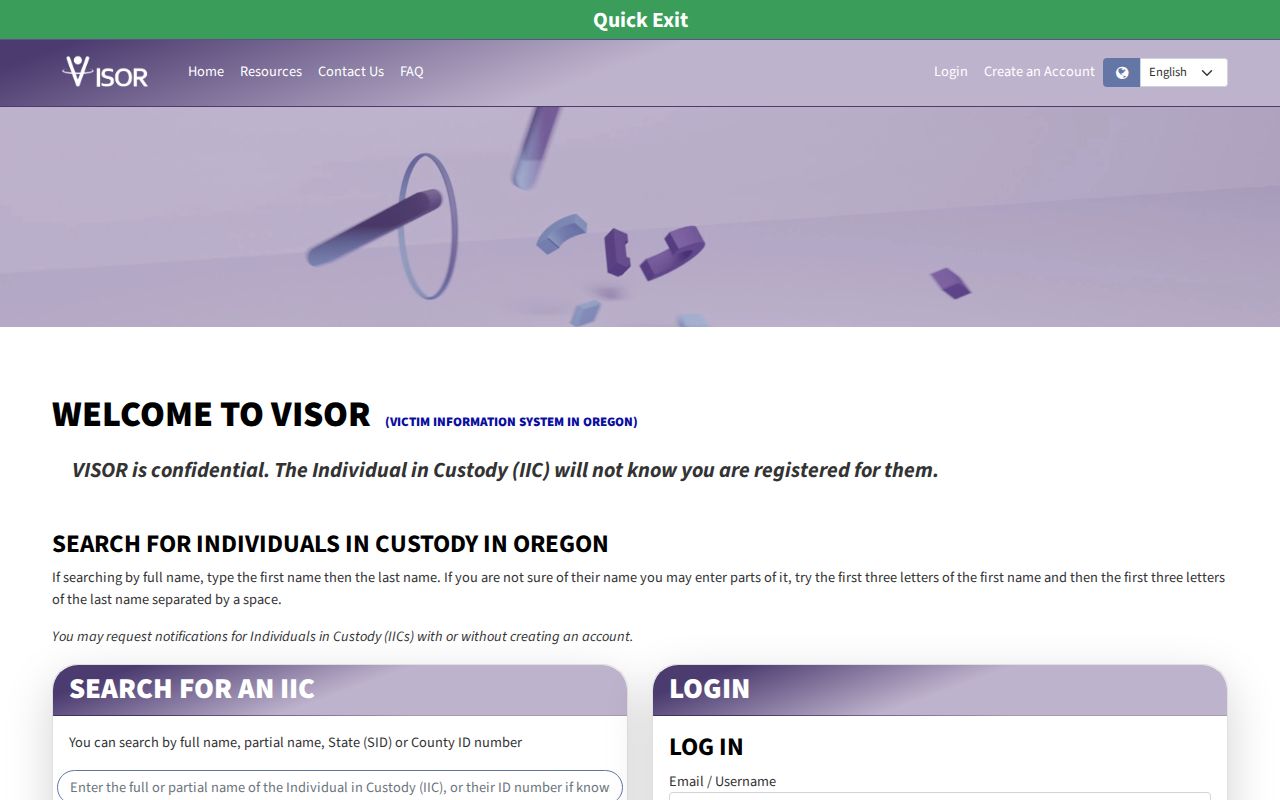
The screen’s current labels should control each search because portal options and participating feeds can change.
Search Deschutes County VISOR Records
Begin with one specific person and the strongest identifier available. A SID is useful for an ODOC match. A county ID can help with a participating local record. When only a name is known, use the complete spelling first, then a partial name if needed. Shared names, suffixes, aliases, and data-entry differences can produce a wrong or missed match. Never join details from two records merely because their names look alike.
- Open Oregon VISOR and choose the person-search function shown by the live portal.
- Enter a full or partial name, SID, or county ID. Use only the fields needed for a focused result.
- Compare all displayed public identifiers. Open the profile only when the identity is reasonably matched.
- Read the exact agency, status, event, and date labels. Save the access date because those fields can change.
- If Deschutes County is listed as offline, contact VISOR support and use the jail’s direct channels instead.
If the person’s last known event was a local arrest, first compare the result with the DCSO current-inmate page. DCSO says its roster is continuously updated and reflects current custody. Its separate bail information says the linked custody list can also identify someone released within the last 24 hours. A missing name alone proves neither release nor transfer.
For a named-person inquiry that spans more than one system, the Deschutes County release search explains the full local, state, court, and federal sequence.
Note: Use the agency and status shown on the profile, not the VISOR search result alone, when describing a custody change.
Deschutes VISOR Release Fields
A VISOR profile can support a present custody or supervision check. Official VISOR material confirms the available search identifiers, broad coverage, agency and status reading, and notification workflow. It does not support a claim that every result has one fixed set of fields. Read only what the current record actually displays. In particular, do not relabel a projected date as an actual release date.
| Field or element | What it can establish |
|---|---|
| Name and identifier | Helps distinguish the intended person from similar names |
| Agency | Identifies the participating custodian or supervision source tied to the record |
| Custody or supervision status | Shows the portal’s periodically updated status, not a certified history |
| Status event | May describe a qualifying custody or supervision change using the portal’s wording |
| Projected release date | A changeable estimate when displayed, not proof that release occurred |
| Notification options | Shows events and contact methods offered for that profile |
A supervised result can corroborate that a state prisoner left physical custody for parole or post-prison supervision. It does not prove final discharge. Probation can begin without a prison stay, so a probation-related result does not prove a past prison release. Likewise, an absent profile can follow full discharge, an offline feed, a name mismatch, or limited coverage.
The ODOC offender-search explanation and Oregon Offender Search serve a different role. OOS is the public ODOC lookup for state-corrections records and projected dates. VISOR emphasizes current custody, supervision, and alerts. Neither system replaces an official release transaction when formal confirmation is needed.
Request Deschutes County Release Alerts
Notifications are tied to a correctly matched profile and the events that VISOR offers for it. The portal states that a person can request notifications with or without creating an account. An account may make preferences easier to manage, but it is optional. Contact methods and qualifying events must be taken from the live form rather than assumed.
- Search for the person and open the carefully matched VISOR profile.
- Select or request notifications from that profile.
- Choose an event and contact method that the current form offers.
- Enter the requested contact details accurately.
- Complete the live verification or confirmation prompts and keep the confirmation.
No current official source reviewed for Deschutes County documents the old VINE phone-PIN process. Older instructions may refer to one, but the current VISOR prompt is controlling. Do not create or expect a four-digit step unless the live portal itself asks for it. This distinction prevents a legacy workflow from blocking a valid current registration.
VISOR says it supports custody-change and qualifying projected-release-date notices. A notice signals that the data source reported an event. It is not the release order, jail transaction, or ODOC discharge record. If timing or destination matters, call the holding agency after receiving the alert.
Note: Keep the profile identifier and confirmation details, but recheck contact information whenever the portal offers a way to update it.
Deschutes Release Notification Gaps
Oregon VISOR lists offline jails. That status should be checked at the time of each Deschutes County search. If Deschutes is shown as offline, a blank or stale result cannot resolve whether the person remains in custody, was released, or transferred. VISOR support is available at 855-691-6246 around the clock and at VISOR@doc.oregon.gov. The portal states that email responses are provided within three business days.
For an urgent local custody check, call the Deschutes County Adult Jail information line at 541-388-6661. Ask whether the person is no longer in DCSO custody, the actual departure time, and whether the event was a community release or a transfer. Staff may limit what can be shared. For documentary proof, use the DCSO JustFOIA request portal and seek the custody and release transaction, authority, type, and destination.
The county’s posting-bail page documents the last-24-hours capability and directs release-date questions to the jail. That local route is important because VISOR is an alert layer, not the source that physically checked a person out of the Deschutes County Adult Jail.
Confirm Deschutes County VISOR Alerts
VISOR does not cover federal Bureau of Prisons custody. A federal case uses the BOP inmate locator, and immigration custody uses the ICE detainee locator. A person transferred from DCSO to another custodian may disappear from one source before appearing in the next. That gap is not proof of community release. Obtain the receiving agency from the county record and continue with the correct system.
For an ODOC case, search OOS by SID when possible. The projected release date can change, and the public result is not a certified former-offender record. After release, ODOC Former Offender Records at 503-570-6919 or a Public Pen Pack request can supply stronger evidence, such as first and last face sheets, sentence orders, a release or discharge transaction, and certain parole records.
For a DCSO event older than the documented 24-hour view, call the jail or request the record. Ask for the actual departure date and time, legal authority, release type, and destination. A court judgment can explain why release was authorized, but it does not prove the physical checkout time. Final confirmation pairs the custodian’s transaction with the relevant court or supervision record.
Read Deschutes Release Status Carefully
“In custody,” “released from physical custody,” “transferred,” “under supervision,” and “discharged” describe separate states. A transfer out of the Deschutes County Adult Jail can lead to ODOC, another jail, a federal authority, or another jurisdiction. It should not be reported as freedom from custody. A release to PPS means physical prison custody ended while supervision continued.
Preserve the correctly matched identifiers, agency, exact status wording, event date, source, and access date. If the evidence came from a phone call, record the unit, number, time, and precise fact confirmed. A later correction, changed projected date, or final discharge should be documented as a new event rather than silently replacing the earlier snapshot.
Negative searches require the same care. “Not found in the public systems checked” is accurate. “Released” is not, unless an agency record states the release. VISOR gives Deschutes County a useful notification layer, but sound confirmation still follows the person from the last known custodian to the next status.
A practical confirmation log should keep each source in sequence. Note the DCSO snapshot first when the matter began at the Adult Jail. Add the VISOR profile and its exact agency label next. If ODOC appears, record the SID and OOS status without merging the projected date with the alert event. Then add the court order or judgment only as the legal basis. This order exposes conflicts instead of hiding them. For example, a DCSO transfer date and a later ODOC admission can both be correct, while neither proves an immediate release to the community. If a phone call resolves the conflict, preserve the number called, agency unit, time, and exact fact confirmed. The resulting timeline remains useful even after a live portal changes.