
Deschutes Parole and Probation Compared
Probation is a court-ordered sentence served in the community. It may follow a short jail stay, but it can also begin without a prior prison release. Parole is release from prison under supervision in cases where Oregon law and the sentence place release authority with the Oregon Board of Parole and Post-Prison Supervision, known as BOPPPS. Post-prison supervision, or PPS, is the community-supervision term used for many people leaving an Oregon prison. Short-Term Transitional Leave, or STTL, is a structured pre-release status for an eligible person. These labels are not interchangeable.
Deschutes County Adult Parole and Probation supervises county residents sentenced to felony or specified-misdemeanor probation and people released from a correctional facility to parole, PPS, or transitional leave. Its public page currently reports 19 officers and about 1,000 clients, but gives no date for that displayed count. The figure describes a local workload, not the number of releases. Daily contact is local. BOPPPS has a different role in setting conditions, issuing supervision warrants, and approving certain sanctions or returns.
| Status | How it begins | What it proves |
|---|---|---|
| Probation | A court imposes community supervision | A sentence status, not by itself a prior jail or prison release |
| Parole | An eligible prison term moves to Board-controlled supervision | Release from physical prison custody into supervision |
| Post-prison supervision | An ODOC sentence reaches its supervised community phase | Physical prison release, but not final discharge |
| STTL | An eligible person enters structured transitional status | Physical departure under restrictions, not sentence completion |
- Discharge
- The formal end of a custody or supervision obligation, depending on the record’s exact wording.
- Absconder
- A supervised person alleged to have stopped required contact or left supervision without permission.
- Detainer
- A request or hold from another authority that can route a person into different custody.
- Revocation
- A legal process that can end community placement and return a person to custody.
Note: Active probation confirms supervision, but it does not establish that the person served or completed a Deschutes County jail term.
Verify Deschutes Post-Release Supervision
No official public Deschutes County client-name search was located. There is also no official county absconder list in the reviewed sources. Verification therefore uses several records that answer different questions. Oregon Offender Search, or OOS, is the ODOC public lookup. Oregon VISOR can show a person who is in custody or under supervision. The court record supplies the judgment, probation order, amended judgment, or revocation entry. The local office can confirm its role when disclosure is authorized.
A name match is not enough. Use a State Identification Number, or SID, when possible. Compare a full name and other public identifiers before relying on a status. Then read the agency and the precise label. “Under supervision” is not the same as “discharged.” A probation result does not prove prior prison custody. An active parole or PPS status more strongly supports physical release from ODOC, yet the actual release transaction remains the best proof of the date and destination.
- Identify the last custodian and case. Decide whether the person was in the Deschutes County Adult Jail, an ODOC prison, or only subject to a community sentence.
- Search OOS by SID or a complete or partial name. Open only a carefully matched identity and record the status label and access date.
- Check Oregon VISOR by name, SID, or county ID. Read the listed agency, custody status, and supervision event.
- Review the public court case for the operative judgment, probation, PPS, or later revocation order. A court order explains authority but not the exact physical checkout time.
- Call Deschutes Adult Parole and Probation at 541-385-3246 for the responsible office and any information it may lawfully confirm.
If the main question is whether the person left the county jail, seek the actual DCSO release transaction. A person may have transferred to ODOC or another custodian instead of entering the community. The Deschutes County released-inmate search sets out that custody-to-release evidence path.
Deschutes Parole Offices and Roles
Deschutes County Community Justice performs day-to-day adult parole and probation work. The Bend office is the main local point, while Redmond has an intake location. The BOPPPS supervision description explains the state Board’s role. The Board establishes conditions in matters within its authority, issues supervision warrants, and acts on specified sanctions and returns. It does not replace the officer who manages routine reporting, services, and compliance in Deschutes County.
Deschutes Adult Parole and Probation
Bend main office
63360 NW Britta Street, Building 2
Bend, OR 97703
Redmond intake
737 SW Cascade Avenue
Redmond, OR 97756
Phone: 541-385-3246
The county’s supervision page is useful for local responsibility. It is not a public roster. BOPPPS records answer Board-specific questions, while OOS and VISOR provide limited public status views. When a documentary history is needed, ODOC Former Offender Records can be reached at 503-570-6919, or a public-records request can seek a last face sheet and discharge-of-parole record.
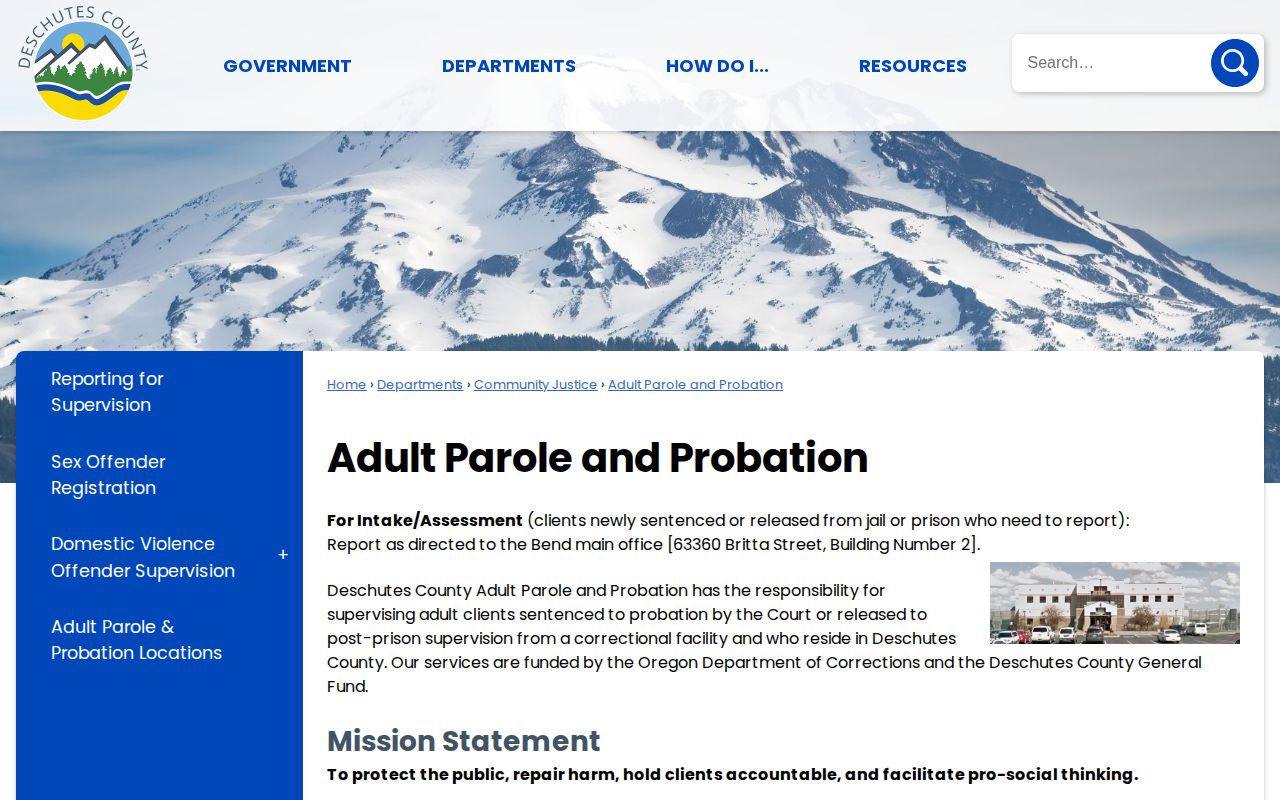
That official source identifies the local client groups and keeps daily field supervision distinct from the state Board’s duties.
The official BOPPPS hearing calendar does not list every prison departure. Board jurisdiction depends on the sentence era, offense, and legal basis. No public name-based Board decisions database was found. An absent hearing entry therefore does not show that a person was never released, on supervision, or discharged.
Note: Board hearing notices and business meeting minutes serve different purposes and are not substitutes for a person’s supervision or discharge record.
Deschutes Supervision Warrants and Violations
Supervision conditions are the enforceable rules attached to probation, parole, PPS, or transitional leave. They can include reporting, travel, treatment, contact, residence, and case-specific terms. The exact signed conditions and court or Board order control. A general agency page cannot establish one person’s duties. A suspected violation also does not prove that a warrant has issued, that supervision was revoked, or that the person returned to custody.
An absconder label generally means the supervising agency alleges that required contact stopped or the person’s location is unknown. Because Deschutes County publishes no public client or absconder search, do not infer warrant status from a missing OOS or VISOR result. A fully discharged person may no longer appear. A system may also update on a delay. The local office, the court register of actions, and an agency warrant record are stronger routes. BOPPPS can issue supervision warrants in matters within its jurisdiction, while a court handles probation proceedings.
VISOR may provide a custody or supervision change alert for a correctly matched person, but it is not a certified record. A new jail booking should be checked in DCSO’s current-custody system. If a transfer occurs, follow the receiving agency rather than describing the person as released. Keep the source, access date, exact status, and agency with any conclusion.
Deschutes Probation Intake Process
The county’s reporting instructions give unusually concrete details for a person newly ordered to supervision. That person should call promptly, have the case number ready, and schedule the time and location by the judge’s deadline. The county says appointments are generally available the same or next business day during normal intake hours and take about one hour. Those facts describe client intake. They do not create a public right to obtain client details.
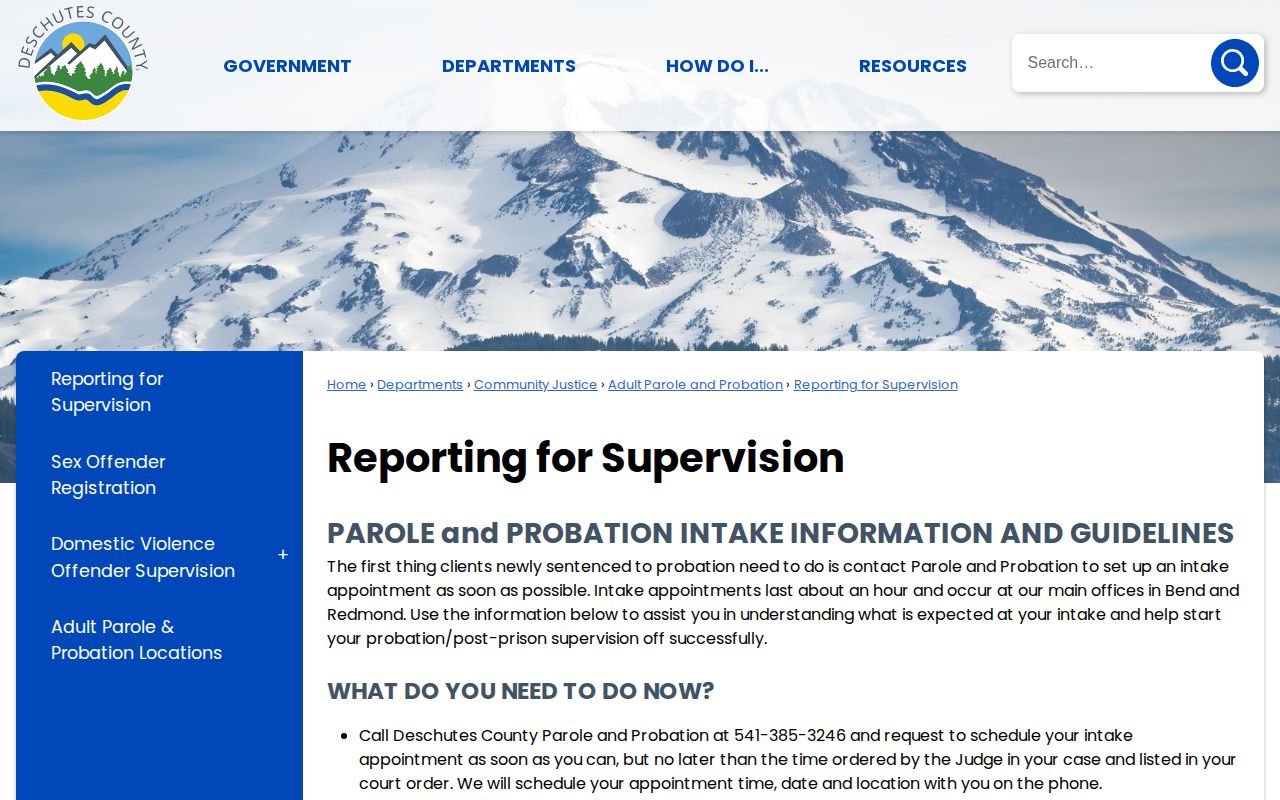
The published screen helps a supervised person prepare for intake while protecting the county’s nonpublic client list.
During intake, staff provide an information packet and review conditions. The process may include a mouth-swab DNA sample, a photograph, an assessment, and later appointments. Out-of-state residents receive separate instructions: bring proof of residence and a $50 money order payable to the State of Oregon, and do not assume immediate permission to leave Oregon. The $50 amount is an interstate-supervision intake instruction, not a lookup fee.
Cascades East Transit Route 4 is identified by the county for the Bend office, and Route 24 is identified for Redmond. A person ordered to report should still confirm the appointment site before travel. The two-office arrangement helps explain why a Deschutes County supervision record may point to Bend or Redmond rather than a single countywide intake desk.
Documents After Deschutes Release
Release from physical custody and the start of supervision often occur close together, but each agency manages its own part. The DCSO jail property instructions state that remaining jail-account funds are returned at release and booked property is accounted for and returned. Property that cannot travel during a transfer may be held under policy for up to 30 days. A transfer to ODOC or another jail is still custody, so property handling does not prove community release.
At the state level, ORS 421.125 addresses ODOC attention to suitable clothing, money, and documents at discharge or parole. These practical steps matter because an identity document, release paper, and supervision instructions may be needed at intake. The release record should still identify the legal authority, actual date, and destination. Property return is supporting context, not a substitute for that transaction.
The supervised person should keep copies of the judgment, conditions, reporting details, and later discharge record. A family member or other requester should use official public channels and respect any withheld personal or safety information. Records can be limited even when the office’s general role is public.
Note: Property return can accompany release, transfer, or discharge processing, so it should never be treated as the sole proof of status.
Deschutes Supervision and Final Discharge
Physical release is not always the end of an Oregon sentence. A person may leave prison to parole, PPS, or STTL and remain under enforceable conditions. Final discharge is a later legal milestone. For probation, the court record may show completion, early termination, extension, violation, or revocation. For parole or PPS, ODOC and BOPPPS records may document the end of supervision. Always quote the record’s actual label.
A Public Pen Pack can include public-information prints, first and last face sheets, judgments or sentence orders, and in some cases parole discharge or violation material. ODOC’s Public Records Center is the formal request route. A narrow request for the last face sheet and discharge-of-parole record may be more direct than asking for every file.
Preserve the physical release date and supervision discharge date as separate fields. Record the agency, source, access date, and any limit stated by the system. This distinction is vital in Deschutes County, where local officers handle daily supervision but state and court records supply different parts of the legal history.