
Deschutes Projected and Actual Release Dates
A projected release date is a current calculation. It uses the judgment, sentence structure, certified jail-time credit, applicable earned time, and legal rules. Oregon Offender Search labels the ODOC field “Projected Release Date.” That wording matters. It is not a guarantee, a final order, or proof that a person later left custody. The actual release date is the date recorded when the holding agency completes the physical departure or transfer.
A pretrial detainee in the Deschutes County Adult Jail does not have a sentence-based release date. Security may be posted, a court can order recognizance or conditional release, charges can be resolved, or another hold can keep custody in place. DCSO warns that expected dates may change through court action or work and good-time credit. A bail amount or court order can authorize release without recording the exact checkout time.
Sentenced people also require a custody distinction. A local jail sentence is administered through the county jail and court. An ODOC prison term is computed by Oregon corrections. A DCSO departure marked as a transfer to ODOC is not a community release. Follow that person into the ODOC system before giving any date a broader meaning.
Note: A person can leave one facility on a projected date yet remain in custody through a detainer or transfer.
Find Deschutes Inmate Release Dates
Start with the last known custodian. For a local arrest or county sentence, use the DCSO inmate-search wrapper and its live JailTracker link. DCSO calls the list continuously updated and current-custody focused. Its posting-bail information also states that the custody list can determine whether a person was released within the last 24 hours. Older local dates require a phone call or record request.
For an ODOC prisoner, the Oregon Offender Search is the official public date lookup. Search by SID when possible. A complete or partial name also works, but similar identities need care. The ODOC sentence-recalculation FAQ expressly identifies OOS as the official place to see an offender’s release date and states that the Projected Release Date appears there.
- Identify whether the person is pretrial, serving a county jail sentence, committed to ODOC, or already under supervision.
- For county custody, check DCSO’s current and documented last-24-hours functions. Call 541-388-6661 if the result is absent or unclear.
- For state prison, search OOS by SID or name and open the carefully matched record.
- Copy the exact date label, status, source, and access date. Do not shorten “Projected Release Date” to “release date.”
- Review the operative judgment and amendments through Oregon court records when the sentence or credit basis must be understood.
- After the projected day, obtain the actual jail or ODOC transaction and the destination or supervision status.
The OOS criteria screen is visible at the official ODOC search source.
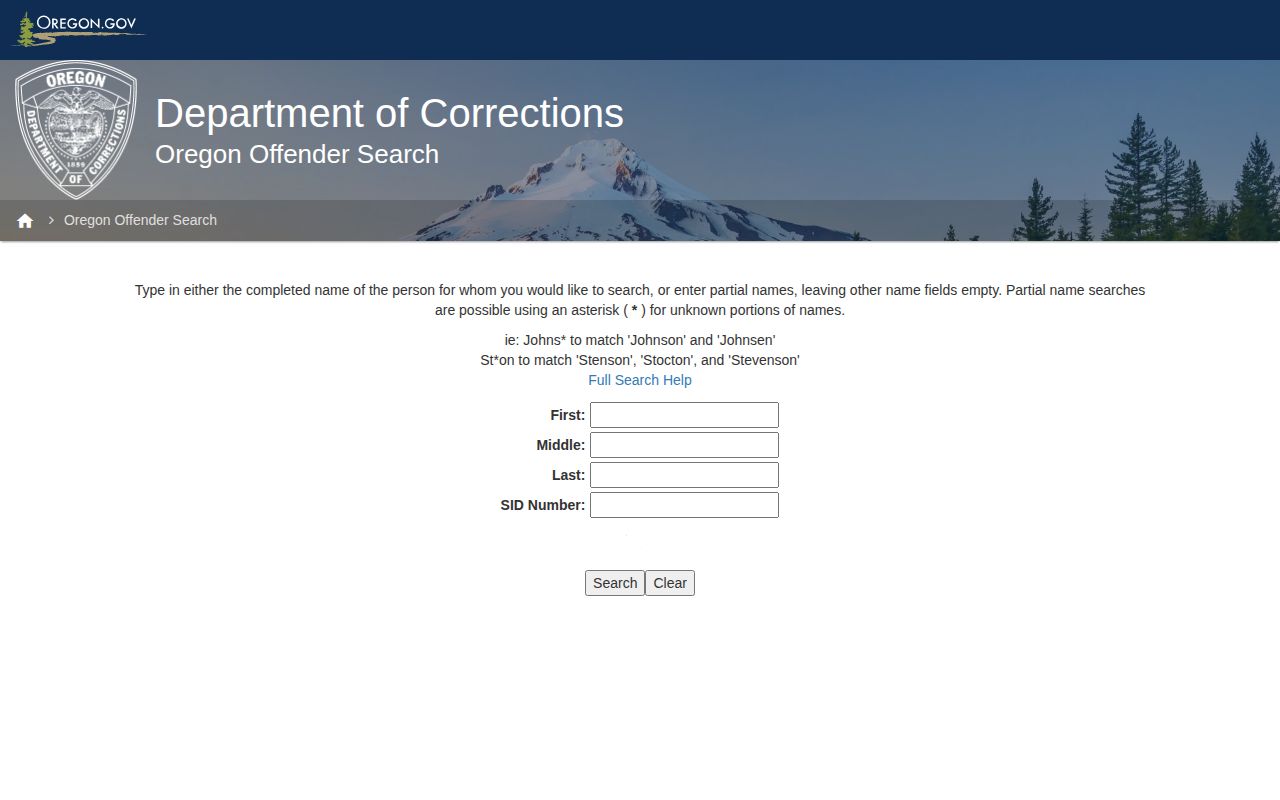
The criteria page is for state-corrections records and should not be treated as a history of jail-only custody in Deschutes County.
Oregon Earned Time for Deschutes Releases
Oregon does not have one blanket rule requiring every prisoner to serve 85 percent. Applying that shortcut to a Deschutes County inmate release date can produce a false answer. For eligible ODOC felony terms imposed for crimes committed on or after November 1, 1989, ORS 421.121 allows earned-time credits for suitable institutional conduct and adult-basic-skills participation. The maximum can reach 20 percent of the total incarceration term, subject to a six-month minimum actual confinement rule and individual eligibility.
The ordinary maximum may suggest 80 percent for an eligible term, but it is not a universal release formula. ORS 421.121 excludes sentences governed by listed statutes, including ORS 137.635, 137.700, 137.707, 163.105, 163.107, and 163.115. Measure 11 mandatory minimum sentences under ORS 137.700 are not reduced by ordinary ORS 421.121 earned time. The judgment, offense, date, and sentence structure must be read before any credit is applied.
Older cases differ again. Pre-November 1989 terms may fall under the historical good-time framework in ORS 421.120. Court credit is governed by ORS 137.370. In the recalculation setting described by ODOC, a qualifying amended judgment must expressly state presentence incarceration credit under ORS 137.370(4). This makes the actual judgment and any amendment central to the computation.
Do not apply the ODOC 20 percent rule to a Deschutes County jail sentence. Local credit, court orders, holds, jail policy, and the particular sentence control that release. Call DCSO or review the court file. A formula designed for an eligible state felony term cannot answer a local pretrial or county-jail question.
Note: Maximum credit describes a legal ceiling for eligible terms, not a promise that every eligible person will receive that amount.
Deschutes Release Date Formula Limits
The most useful calculation starts with the sentence document rather than a percentage. OISC, the Oregon Corrections Information System, establishes the ODOC case file and computes time from the judgment and certified time-served information. Consecutive and concurrent sentence structure matters. A judgment amendment can change credit. An appellate interpretation can also require ODOC to recalculate dates across affected records.
Physical prison departure has several possible forms. An eligible person may enter Short-Term Transitional Leave under ORS 421.168 and applicable ODOC rules. Another person may leave prison to parole or post-prison supervision. A detainer may send someone to another jurisdiction. Full discharge is a different endpoint. The projected date alone does not say which path occurred.
- Earned time
- A potential reduction available only under the rules that apply to an eligible sentence.
- Custody credit
- Credit for qualifying time already held, as governed by the judgment and Oregon law.
- STTL
- Short-Term Transitional Leave, a structured physical departure for an eligible person before ordinary release.
- Measure 11
- Oregon mandatory minimum sentencing provisions that exclude covered minimum terms from ordinary earned-time reduction.
- Discharge
- The end point stated by the governing agency record, which may differ from release to supervision.
For a county-jail-only person, the court can show a term, credit order, release agreement, or amended judgment. DCSO supplies the physical transaction. For an ODOC person, the state computation and later release record control. Keeping those tracks separate is safer than building a single Deschutes release-date calculator.
Why Deschutes Release Dates Change
A projected date can move before the person leaves custody. ODOC’s official sentence-recalculation FAQ documents the effect of legal interpretation and corrected sentence calculations. Other changes can arise from an amended judgment, revised custody credit, earned-time status, misconduct, program participation, a detainer, Board or Governor action, or correction of source data.
| Factor | Possible effect | Best record to check |
|---|---|---|
| Amended judgment | Changes sentence terms, structure, or stated credit | Operative court judgment and ODOC computation |
| Custody-credit correction | Moves the computed date earlier or later | Time-served certification and sentence computation |
| Earned-time status | Changes the credit actually applied within legal limits | ODOC face sheet or computation |
| Misconduct or program status | May change earned credit or eligibility | ODOC calculation and authorized decision |
| Detainer or hold | Routes the person to another custodian instead of the community | Release transaction and receiving-agency record |
| Parole or Board action | Sets, defers, or changes a date only in cases within Board authority | BOPPPS action form and ODOC record |
The official ODOC recalculation FAQ supplies the source view shown below.
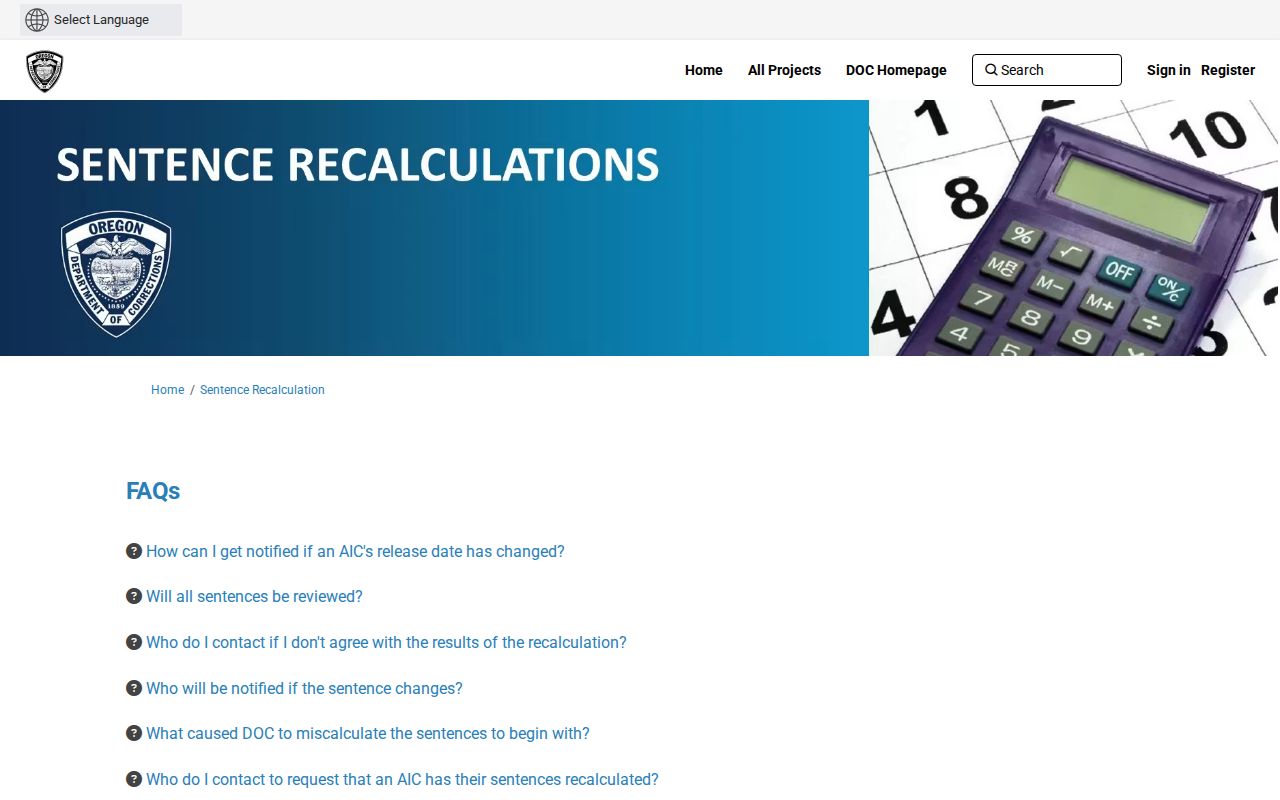
Its recalculation context shows why a copied date should always include the date on which it was viewed.
Confirm Deschutes County Jail Release Dates
For a Deschutes County Adult Jail departure, call the jail information line at 541-388-6661 when the live system is unclear. Ask whether the person is still in DCSO custody, the actual date and time of departure, the release category, legal authority, and whether the person entered the community or transferred. Staff may restrict details, but the transfer question prevents a serious error.
A formal request can be filed through the DCSO JustFOIA portal. Include the full name, date of birth if known, arrest or booking date, booking or case number, and the exact fields sought. Request the admission date and time, actual release date and time, authority or order, release type if maintained, and receiving agency or destination. Ask for a code definition when the record uses an unexplained abbreviation.
The DCSO Records Unit is at 63333 Highway 20 in Bend and can be reached at 541-388-6655 on weekdays from 8 a.m. to 5 p.m. The county advises allowing up to 21 days for records and says complex matters may take longer. That is practical county guidance, not a promise that every request will be produced by a fixed day.
Court records provide the legal basis. Deschutes Circuit Court case copies can include a judgment, amended judgment, release order, and later probation or revocation entries. Pair them with the jail transaction because an order can authorize departure without recording when DCSO physically completed it.
Note: A current-roster disappearance must be described as an unresolved status until DCSO confirms release, transfer, or another disposition.
Confirm Deschutes State Release Dates
After an OOS projected date passes, the question changes from when release may occur to what actually happened. Read the new ODOC status and check Oregon VISOR for custody or supervision changes. The Deschutes VINELink release-check instructions explain Oregon’s current VISOR workflow and its alert limits. A notification remains an indicator, not a certified release record.
For documentary proof, contact OISC Former Offender Records at 503-570-6919 or use the ODOC Public Records Center. A focused request may seek the first and last face sheets, sentence computation, projected and actual dates, release or discharge transaction, destination or status, judgment, and any discharge-of-parole record maintained in the Public Pen Pack.
Preserve physical prison release and final supervision discharge as separate dates. A person released to parole, PPS, or STTL is outside physical prison custody but has not necessarily completed the sentence. If a detainer caused transfer, preserve both the ODOC departure and the receiving agency’s admission.
Preserve Deschutes Release Date Evidence
A sound date record keeps the correctly matched identifiers, last custodian, exact displayed label, snapshot date, sentence source, and any warning shown by the system. After release, add the actual departure date and time, category, authority, destination, supervising agency, and source document. This small record helps separate a forecast from the event.
If the source is a phone confirmation, record the agency unit, number called, call date and time, and the precise fact staff confirmed. Do not add an inference about freedom from all custody. If a transfer is reported, follow the receiving custodian. If the system later corrects a field, keep the correction date and corrected value.
Negative online results are limited. A sealed matter, spelling variation, fully discharged status, juvenile restriction, system outage, or short public retention can remove a visible result. The most accurate conclusion is that the person was not found in the named public systems as of the access time. The Deschutes County released-inmate record path then leads back to the last known custodian for an actual transaction.